
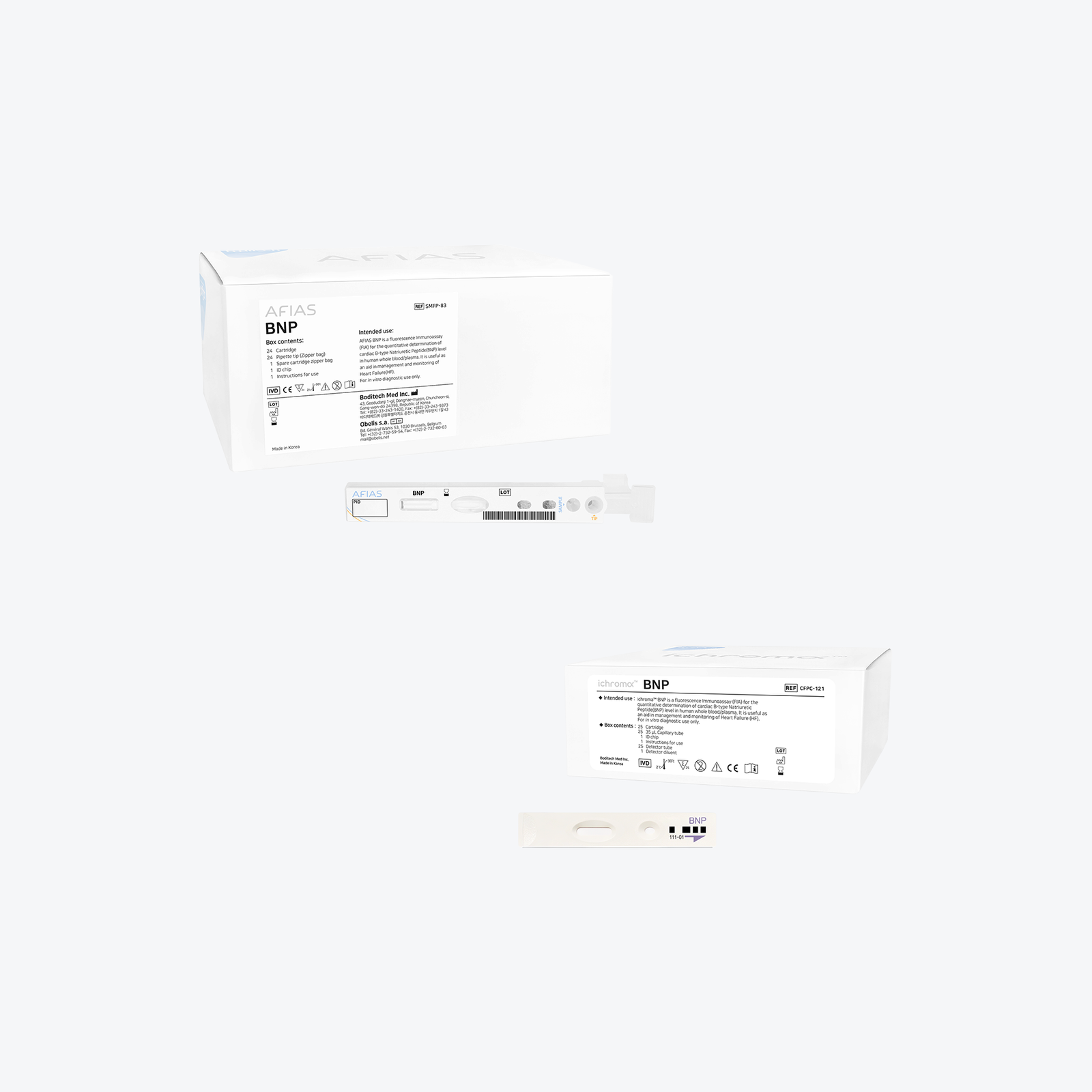

Evaluating ovarian function & predicting controlled ovarian hyperstimulation
AMH levels help predict the remaining egg reserve. This can tell a lot about the reproductive issues, including the onset of menopause, amenorrhea, polycystic ovary syndrome. This test also tells the expected response to controlled ovarian hyperstimulation to achieve pregnancy in IVF.

plasma, serum
12 mins
ichroma AMH: 0.02 – 15 ng/mL
AFIAS AMH: 0.02 – 15 ng/mL
Assessment of ovarian reserve, Diagnosis of ovarian dysfunction such as POI and PCOS, Menopause prediction, Response prediction to controlled ovarian stimulation

Diagnosis of endocrine dysfunction and adrenal disease
This test measures the cortisol level in the blood. One can use the whole blood for ease of sample pretreatment. The test takes 10 minutes, and the result could provide information about adrenal diseases and endocrine dysfunction.
ichroma™ AFIAS
AFIAS ichroma™
whole blood, plasma, serum
10 mins
80 – 800 nmol/L
Cushing’s syndrome, Adrenal cortical dysfunction, Addison Disease, Hyperthyroidism

Diagnosis of early menopause & ovarian degeneration and infertility
This test can help figure out the cause of infertility, problems with ovarian functions, menstrual abnormalities and congenital or acquired gonadotropin development disorder or infertility.
ichroma™whole blood (AFIAS), plasma, serum
AFIAS 12mins
ichroma™ 15mins
AFIAS (1 – 100 mIU/ml)
ichroma™ (1 – 100 mIU/ml)
Premature menopause, Premature ovarian failure, Precocious puberty, Sterility, abnormal menstruation

Supporting to diagnose and monitor thyroid disease and conditions
Free T4 test measures the level of the hormone thyroxine (T4) in your blood. The thyroid gland produces T4 in response to thyroid-stimulating hormone (TSH). T4 is found in the body in two forms: free T4 and bound T4. A total T4 test can measure the total amount of both free and bound T4 in the blood, while a free T4 test will only measure the amount of T4 in its free form, so it more accurately reflects how the thyroid gland is functioning.
Whole Blood, Serum, Plasma
12 mins
1-100 pmol/L
Diagnosis thyroid function, diagnosis or exclusion of thyroid disease, monitoring response to treatment for thyroid disease

Distinguish pregnancy and abnormal pregnancy
The β-hCG test can be used to confirm pregnancy, the age of the fetus, abnormal pregnancy (ectopic pregnancy), potential miscarriage, and down syndrome.
ichroma™whole blood, plasma, serum
12 mins
5~50,000 mIU/mL
Ovulation induction and Pregnancy, Abnormal pregnancy, hCG secreting tumor

Distinguish pregnancy and abnormal pregnancy
This test helps detect and treat abnormal pregnancy and germ cell tumors as well as early diagnosis of pregnancy by quantification of hCG in the blood with high sensitivity.
ichroma™whole blood, plasma, serum
12 mins
ichroma™(2~5,000 mIU/mL)
AFIAS (2~1500 mIU/ml)
Ovulation induction & Pregnancy, Abnormal Pregnancy

Assessing and monitoring function of pituitary gland
This test helps evaluate pituitary function by quantifying luteinizing hormone in the blood, to diagnose pituitary gland disease, and to determine congenitally or acquired gonadotropin dysfunction.
ichroma™whole blood(AFIAS), plasma, serum
AFIAS 12mins / ichroma™ 15mins
AFIAS (1 – 100 mIU/ml)
ichroma™ (1 – 100 mIU/ml)
infertility and infertility treatment, pituitary function evaluation, early ovarian failure, chronic ovulation failure

Monitoring ovulation abnormalities and predicting miscarriage & ectopic pregnancy
The progesterone test kit measures the level of progesterone in the blood. The progesterone test alone is not enough to diagnose a particular problem. But the result may help provide answers to causes of infertility, risk of miscarriage, ovulation, and ectopic pregnancy.
ichroma™plasma, serum
15 mins
1.4 – 40 ng/ml, 4.45 – 127.2 nmol/L
Diagnosis of ovulation abnormalities, ovulation monitoring in infertility treatment, prediction of miscarriage or ectopic pregnancy

Assessing to diagnose hypothalamic impairments & pituitary disorders
This test helps select and diagnose mammary gland development, infertility treatment and pituitary diseases by quantifying blood PRL.
ichroma™whole blood(AFIAS), plasma, serum
10 mins
AFIAS (1 – 100 ng/ml)
ichroma™ (1 – 100 ng/ml)
Tracking the causes of infertility, amenorrhea. Prediction & monitoring of fertility, menopause.

Assessing to diagnosis & to monitor thyroid diseases(T3)
This test assesses the level of T3 in the blood to diagnose thyroid dysfunction, help to receive appropriate treatment, and help to confirm the treatment effect through periodic measurement.
ichroma™plasma, serum
AFIAS 10 mins, ichroma 16 mins
AFIAS (0.77 – 7.7 nmol/ml)
ichroma™ (0.77 – 7.7 nmol/ml)
Hyperthyroidism, Thyroid nodule, Multinodular goiter, Graves’ disease

Assessing to diagnosis & to monitor thyroid diseases(T4)
Thyroxine (T4) is a type of thyroid hormone. An abnormal amount of T4 may indicate thyroid disease. The T4 test measures total T4, including T4 bonded to protein and free T4. A T4 test will help determine what type of problem is affecting the thyroid.
ichroma™plasma, serum
AFIAS 10mins, ichroma 16mins
AFIAS (10.23 – 300 nmol/ml)
ichroma™ (10.23 – 300 nmol/ml)
Thyroidism, hypothyroidism

Enable monitoring and managing of androgen level
Testosterone plays a key role in the development of male reproductive organs and secondary sexual traits. This test would provide clues on the health of related tissues and organs, which may be related to infertility, tumors in testicles, and even irregular periods in females.
ichroma™AFIASichroma™plasma, serum
15 mins
AFIAS (1.00 – 10.00 ng/ml)
ichroma™ (1.00 – 10.00 ng/ml)
Hypogonadism, Erectile dysfunction, Infertility, Virilization, Polycystic Ovary Syndrome (PCOS)

Diagnosing thyroid dysfunction
One needs an adequate level of thyroid hormone. The excessive or insufficient level would cause various abnormalities in human physiology. The TSH test can deliver the required answer about the hormone level in 12 minutes (US FDA 510k; AFIAS TSH).
 AFIAS-6
ichroma: serum, plasma
AFIAS: whole blood, plasma, serum
ichroma 12 mins
AFIAS 12 mins
ichroma (0.09-100 μIU/mL)
AFIAS (WB/S/P: 0.09-100 μIU/mL)
Thyroid gland disease,
Thyroid dysfunction,
Subclinical thyroid dysfunction

Supporting to diagnose abnormal thyroid functions with high sensitivity
One needs an adequate level of thyroid hormone. The excessive or insufficient level would cause various abnormalities in human physiology. The TSH test can deliver the required answer about the hormone level in 12 minutes with fingertip blood.
ichroma™whole blood, plasma, serum
12 mins
AFIAS (0.08 – 50 μIU/ml)
ichroma™ (0.1 – 50 μIU/ml)
Thyroid gland disease, Thyroid dysfunction, Subclinical thyroid dysfunction

Reviews
There are no reviews yet.